Building
Carthona
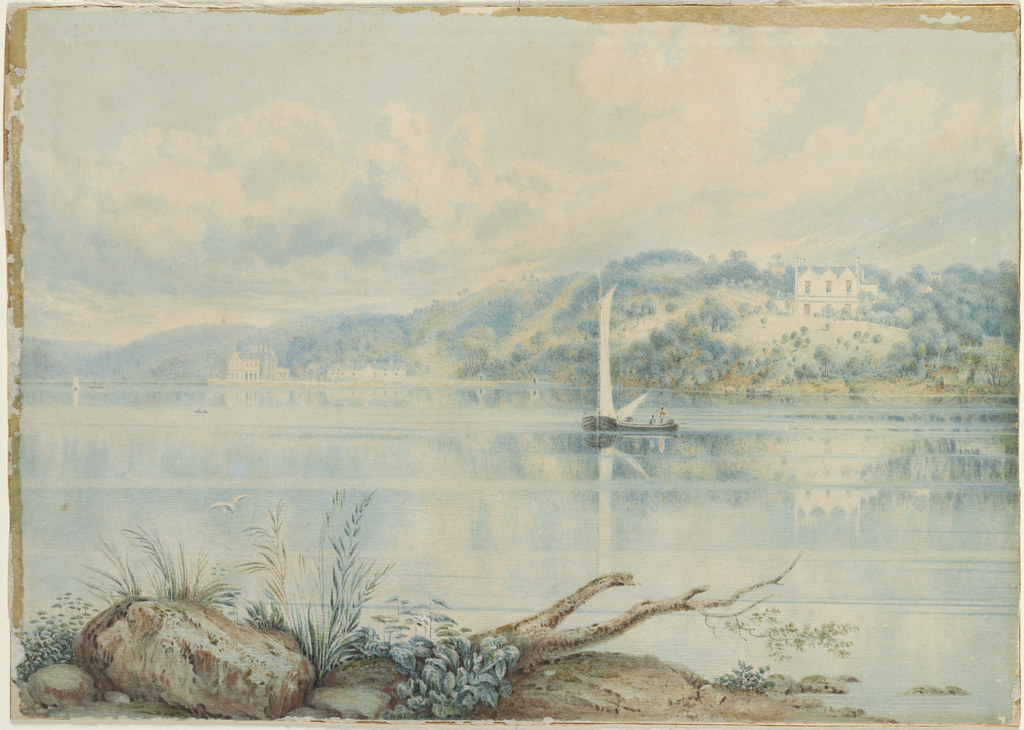
Sir Thomas Mitchell's sandstone villa at the water's edge, 1841.
Carthona was finished in 1841 for Sir Thomas Mitchell, Surveyor-General of New South Wales — the man who mapped the colony's interior and who, for the final fourteen years of his life, chose to live on the water's edge of the peninsula he had helped to survey.
Mitchell had been in the colony since 1827, originally as Assistant Surveyor-General and from the following year as Surveyor-General, a post he would hold for the rest of his life. He led four major expeditions into the interior — across what is now central New South Wales, into the Murray River system, and up into what would become Queensland — and produced the colony's first accurate maps. By 1840, with his public work largely finished and his reputation made, he turned his attention to a house.
He chose a sloping waterfront parcel on the southern shore of the Darling Point peninsula, a short walk down the hill from John Verge's Lindesay, which had been finished four years earlier. Mitchell designed the villa himself, drawing closely on the picturesque Gothic cottages of the English Lake District — particularly a house he had admired near Windermere. Carthona is the result: a single-storey sandstone residence set almost on the water itself, with crenellated parapets, gabled bays and a long curved verandah to the harbour.
A house built partly by hand
Mitchell is said, credibly, to have carved some of the ornamental stonework himself — several of the window and door keystones show the same hand that made his maps. The sandstone came from the site and from the nearby Bellevue Hill quarries. The layout is the early-colonial standard: a sequence of reception rooms along the harbour side, service rooms behind, a generous drawing room at the centre. What separates Carthona from the comparable villas of the period is simply its siting. Where Lindesay sits on the hill behind its grounds, Carthona sits on the water — the verandah drops almost directly to the seawall, and the main rooms look out onto nothing but harbour and sky.
Three families across two centuries
Mitchell lived at Carthona until his death in 1855. The villa then passed to his widow, Mary, and thereafter through the family by descent until the early twentieth century. The second major family to hold the property were the Segenhoes, pastoralists. In 1954 Carthona was acquired by Philip Bushell, of the Bushells tea family — then in his third generation of the business — and has remained in the Bushell family ever since. Philip Bushell died at the house in 1984. Three families, roughly a hundred and eighty-four years: unusual stewardship, even by the peninsula's standards.
Carthona today
Carthona has not opened to the public in the manner of its near-neighbour Lindesay. It remains a private residence, and glimpses of it come only from the harbour. What is visible from the water — the crenellated roof-line, the verandah, the descent of the garden to the seawall — is almost exactly what Mitchell finished in 1841. The grounds have been subdivided over the generations, but the house itself retains its original footprint and, remarkably, most of its original sandstone fabric.
Of all the early villas of Sydney Harbour, Carthona is the one that most clearly explains what the peninsula is for: a private house, at the water, looked after by a single family, across a long arc of time.